Knowledge Vault
A unified memory layer for everything you know
The Knowledge Vault is the persistent memory of RVOS. It stores research, notes, references, project context, and learned patterns in a unified graph that every agent and workflow can read from and write to.
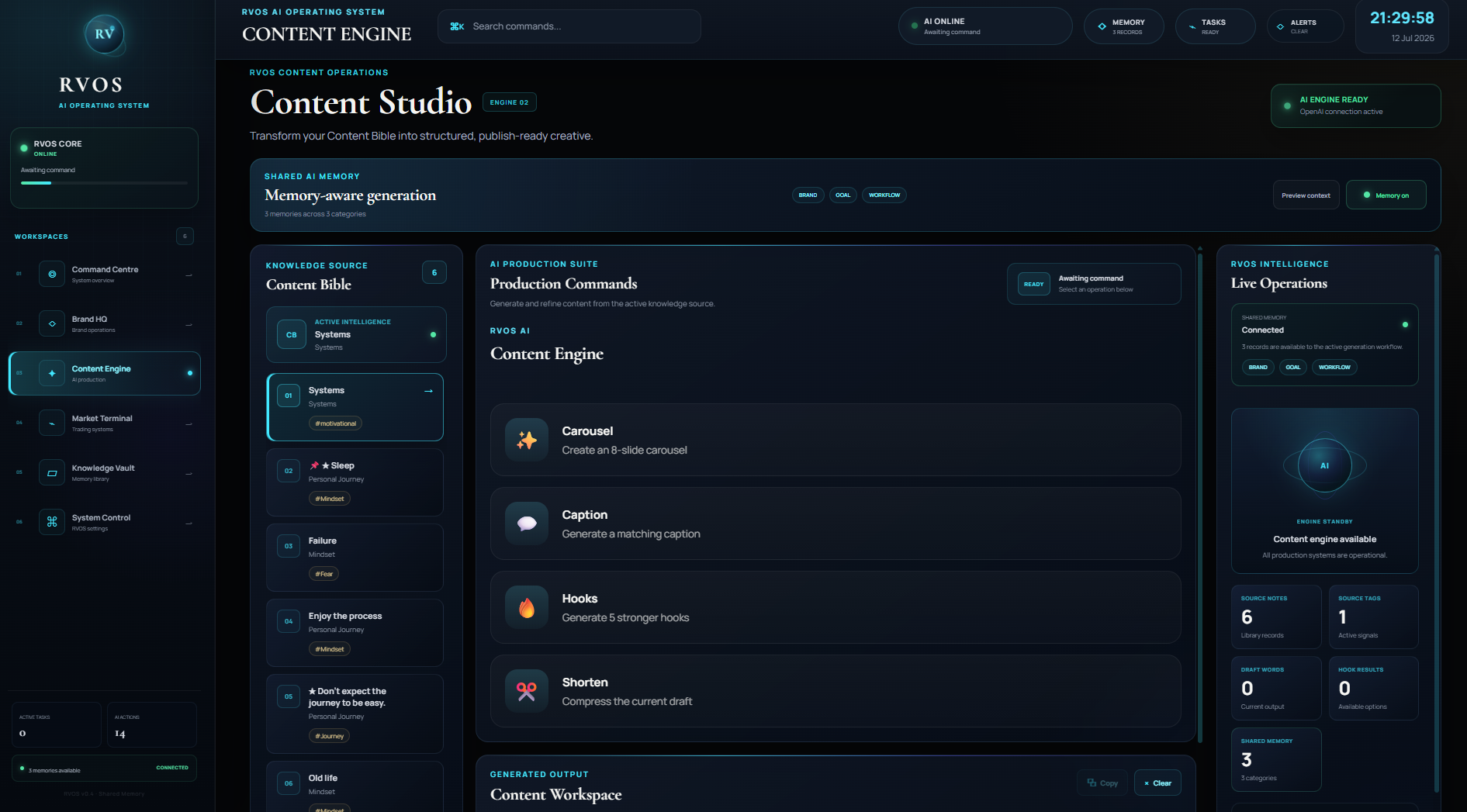
What it does
The Knowledge Vault solves a fundamental problem: AI is only as good as the context it has access to. Most AI tools start every conversation from scratch, forcing you to re-explain your project, your audience, and your preferences every single time.
RVOS takes a different approach. The Knowledge Vault is a persistent graph that accumulates context over time. Research from a past project is available to future ones. Your brand voice, audience insights, and content patterns are all stored and retrievable.
Every agent in the system reads from and writes to the vault. When the research agent discovers a competitor pattern, it is stored. When the writing agent develops a hook that performs well, the pattern is noted. The system gets smarter the more you use it.
Why it matters
Persistent context
Research, insights, and patterns accumulate over time. The system remembers what it learned from past projects.
Unified graph
All knowledge is connected. A research finding links to the project that produced it, the content it informed, and the outcomes it generated.
Agent-accessible
Every agent reads from and writes to the vault. No isolated context windows — everything shares the same memory.
Local-first storage
Your knowledge graph lives on your machine. Sensitive research and proprietary insights never leave your desktop by default.
How it works
Graph database
Knowledge is stored as a connected graph, not flat documents. Relationships between concepts are first-class citizens.
Semantic search
Find information by meaning, not just keywords. The vault understands the relationship between what you ask and what it knows.
Write-back layer
Agents automatically store useful findings back into the vault. The graph grows organically as you work.
Project isolation
Each project has its own context scope, while shared knowledge is available across all projects. You control what is shared.